
Want To Trade City Anxiety For Contentment?
Consider Grounding Yourself In Nature On A Small Farm
Most people report that they are happiest outdoors in Nature.
There are many ways of looking at human happiness – or the lack of it.
One way is to look at contented people who have been well-loved by our world.
An example is Sir David Attenborough, who at 100 years old continues to share his life-long fascination with Nature’s living creation.
His wonderful gift of curiosity is not hampered by anxiety or depression, but is instead free to connect – immediately and directly – to the natural world, and the wonders within it.
A 2010 study in Nature found that city people have a 21% higher risk of anxiety, and a 39% higher risk of depression, than those living in rural areas. This is due to the sensory overload, social and environmental stress, high income inequality, and fast-paced living in urban areas.
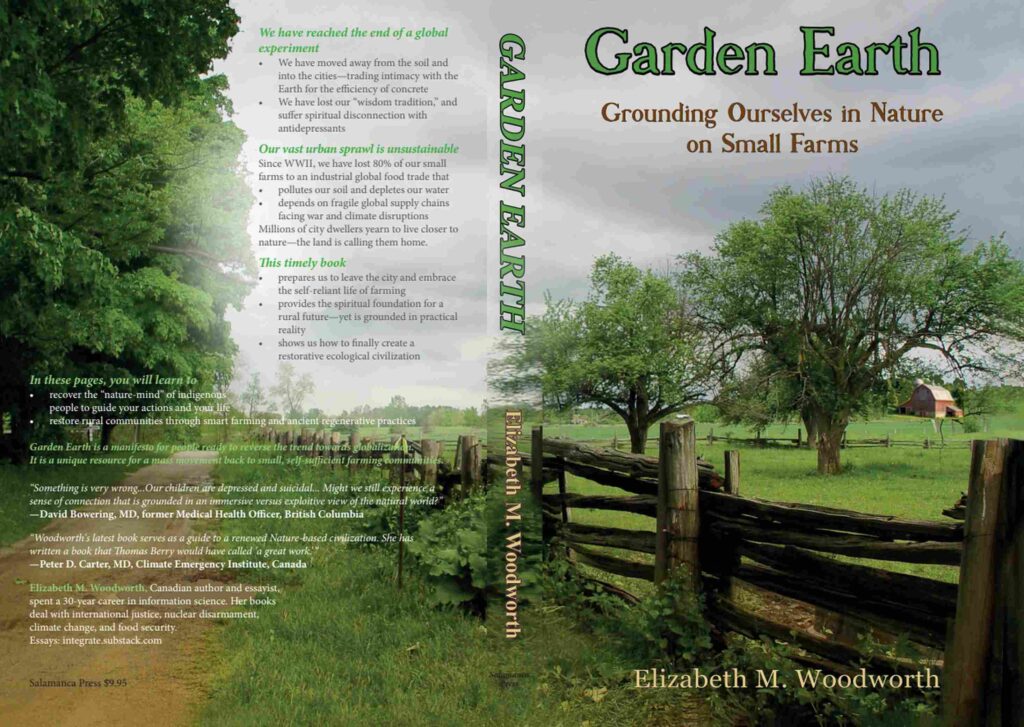
My new book, Garden Earth: Grounding Ourselves in Nature on Small Farms, studies the loss of the “rural calming effect” that preceded WWII – before the situation now, with 80% of Americans and Canadians living in cities.
This article examines Garden Earth’s evidence that we have strayed from our historical mind-sets of intuition, spirituality, mindfulness, and contentment – and offers original ways to regain them.
Lederbogen, F., et al, “City living and urban upbringing affect neural social stress processing in humans,” Nature 474, 498-501. 2011.
What Is The Root Problem In Our Thinking?
Since the industrial revolution and the rise of cities, we have traded our historic “Living Thinking” for “Object Thinking,” trapping us in an analytical, anxious state of mind.
We are taught to look at things (including our bodies and time) as objects to be managed. Object thinking is “the filtering of nature through concepts, in which nature is objectified as a “thing” with observable, analyzable characteristics, and is seen at a psychological distance:
“‘Object thinking,’ which prevents us from flowing directly into the boughs and grasses floating on the wind around us…creates an unbridgeable chasm between us and the world we set out to understand. At the same time, the world becomes an open field for manipulation and exploitation.”
Shifting to “living thinking” is an antidote to this exploitative mind-set. It means becoming more present and less abstract in our thinking, which allows us to return to the immediacy of experience from the distance of object thinking.
The secret lies in turning away from abstract facts and ideas about nature, and moving into a seamless experience where no thoughts intervene – as seen through the phenomenon of the “nature-mind”.
Relating To Nature “From Its Inside” Through Nature-mind
Modern urban stress often comes from feeling like an outside observer trying to navigate a chaotic world.
Stepping outside of that chaotic world into Nature, it is possible to stop looking at nature as scenery, and instead sit quietly until one feels oneself to be a part of it.
As Garden Earth explains,
“Foundational change can only occur if we distinguish between our prevailing state of mind towards Nature, and the ancient, harmonious states of nature-mind which…prevailed during earlier times when we were immersed in Nature and integrated within it. Delving into these opposing states of mind – especially by listening to Nature in a forgotten, ancient way – allows us to relate to Nature from its inside.”
Sinking into listening in this way, without expectation, could be viewed not as an act of the will, or as an exercise, but as a spontaneous natural flow – simply part of the nature of life that pre-dated the anxiety of the modern world.
A Novel Approach To Anxiety: Feeling Our Way In Life
Anxiety is caused by overthinking, over-analyzing, and living entirely within our heads.
Dropping out of the analytical brain and into the senses displaces this buzzing of the mind and substitutes the relief of silence.
This need for relief began with the rise of science and its objectification of the natural world. We were no longer simply in nature. We were above it, living in our minds.
Humankind had changed. Before, human beings had felt their way through life, as animals do: In every moment, animals await instruction from the totality of their sensory and imaginal input before they act…Feeling one’s way is a completely different state of mind.
This is perhaps best illustrated in Garden Earth by the inborn respectfulness of the Hawaiian fisherman upon entering the ocean – of “excusing himself, asking permission, asking forgiveness before going into the area so as not to offend anyone.”
“When I go in the water I go in with purpose, not to make trouble. That’s the aura that I, my being, gives out when I go out there, so that I feel part of the ocean. You give off vibrations, and the life can feel it…they won’t come around. So, if you feel at one with the ocean, the wildlife is more accepting of you.”
It suggests how entering any natural space—even a city park or a backyard garden, with a mindset of asking permission and showing respect—changes our nervous system from low-grade, chronic “fight-or-flight” condition to intimacy and harmony.
Two Meditative Techniques To Enable Nature-Mind
John Palos, fisherman, “Big Island: Hawaii,” from Island Diaries, 2017
“Melting into Nature” (The Dissolution of Self)
This quote from Garden Earth describes a profound, accessible state of oneness that alleviates the exhausting burden of the ego:
“Sometimes, walking outdoors in the quiet – soothed perhaps by a cool breeze on the cheek – we might slip into a silent emptiness. Awareness of walking might dissolve into an enchanted stream of approaching scenery. Sense of self disappears and there is only forest. We are no longer separate from it. This may be described as ‘melting into nature.’ In this state, we are present from within nature, from its ‘inside.’”
Escaping our ego identity isn’t about striving or trying; it’s about slipping into an effortless, quiet emptiness.
Animals can feel it in us, as can plants. An excerpt from Garden Earth tells that
“The beautiful little book, “Thinking Like a Plant,” describes with great care how we can direct our attention to fully absorb the fullness and richness of plants. It is extraordinary how effective this practice of attention can be, and how life-changing it is to open our spirits to the magical world of our rooted companions, and how sacred they can seem when fully experienced.
Plants are creatures, after all…It is quite remarkable to walk along a roadway or path, to concentrate on their lives nearby, and to feel oneself in the presence of them. In that moment, something opens in one’s spirit, and as if by invitation, their richness and luminosity expand magically outward to meet one.
The animals in the vicinity pick up on the communication. A few days ago, as I was melting into love for them, four young deer crossed a grassy lot to approach me quite closely, necks outstretched in expectation. Motionless, we looked at each other for several minutes.
Just this evening on a walk to a nearby duck pond, I stopped to welcome the spirit of a large deciduous tree, and from within the bushes at the base of the tree, a family of four beautiful young racoons assembled from various directions and sat in front of me, their four heads in a line together – again with that intent expectation. It was immediately evident in both cases that by opening my spirit to the plants, it was open to Nature itself. My consciousness was felt by them.”
It appears that our internal vibrations and energy have a tangible effect on the living world around us: when we quiet our inner state, the outer world engages directly with us.
The “Backs of the Eyes” Meditation Technique
Some attempts to meditate can involve wilfully fighting off thoughts.
A more peaceful route to stillness is the physical act of focusing on the eyes themselves to quiet the mind:
“I found that focusing on the backs of the eyes resulted in a release of tension in the eyes themselves, accompanied by an upward drifting of awareness to a quiet place higher up in the inner field of awareness. This release is always accompanied by an involuntary deep breath… when the eyes are opened, they are at complete rest, and the outdoor scenery is transformed into ultra-reality. The eyes are not straining to see… Instead, they are restfully receiving the outer world.”

An Alternative To City Rush: Grounding Ourselves On Farm
If we are to rescue the natural world from our dominant state of mind today, we must choose a balance between our unbridled plundering of Nature and the respect and justice that are embedded in all of Nature, and have been intrinsic to native cultures since time began.
We can learn from them
How to be within Nature,
In among the vines and roots and beetles
Of the black loam soil,
Planting seeds under a pale spring sun.
Or staring up among the apple trees
Crowned with white blossoms
Under the deepest of blue skies…
…and at the same time, work towards food sovereignty by feeding our own communities.

Elizabeth Woodworth is a retired health sciences and environmental librarian, independent researcher, and author with decades of experience exploring environmental issues, climate science, media, and public policy. Since 1987, she has researched and written extensively on topics ranging from climate activism to media influence and historical investigations. Outside of her writing, she enjoys meditation, gardening, walking, travel, and spending time with her pets.






Leave a Reply