
There is a painful moment no one warns you about.
It is not the moment you read the email, or attend the meeting, or hear the words “We are downsizing”.
It is the moment after all of that. The quiet moment. When the house is silent, and the phone is no longer ringing, and you sit alone with a cup of coffee that gets cold because you forgot to drink it.
And in that silence, a question rises from somewhere deep inside you.
Not “How will I pay the bills?”
Not “What am I going to do next?”
A question far more frightening than both of those.
“Who am I now that no one needs me?”
If you are reading this, chances are you have felt that cold, creeping dread. You have watched the headlines about the future of work. You have seen algorithms and automation creep into your daily tasks. And you are wondering if you are becoming obsolete.
I know it because I lived it.
I was a consultant who gave my clients everything I had, building systems and training their teams.
Then one day, I got a polite email telling me that our client did not require my services anymore.
Not because I failed, but because I had been successful enough to make myself replaceable.
This is not a career question. This is an existential question. And hundreds of millions of people around the world are asking themselves the same question today, whether they admit it or not.
We are living in an era where the largest crisis coming is not economic, because economic crises always resolve themselves.
The crisis that has arrived and will continue to grow significantly in the next few years is a crisis of human meaning.
Let us talk about what is really happening to your professional identity, the psychological toll of this invisible wave, and how you can rebuild yourself in a world that seems determined to make you optional.
The Wave That No One Saw Coming
Remember February 2020. You read about a biological virus breaking out in some distant part of the world, and then you just keep on living your life as usual. In three weeks, the entire world will be shut down. We are in the same stage again, but this time it is not a biological virus.
Look at the reality of the job market today.
It is not factory workers getting hit first.
They are professional and technical workers. Financial analysts and accountants are watching tools process data faster and more accurately.
Legal assistants are watching databases get searched faster than humanly possible. Even 49% of Gen Z believe that their college degrees have been devalued.
The statistics are terrifying. But the numbers tell you who is losing jobs. They do not tell you what it feels like when the job you lose is the only answer you ever had to the question: “Who am I if no one needs me?”.
The Collapse of Your Professional Identity
Ask someone you meet at a social gathering: “Who are you?”.
In nine out of ten cases, they will start with what they do: “I’m an engineer,” or “I’m a financial analyst.”
You didn’t hear what they believe in; you heard what they do.
Somewhere inside themselves, they believe they are what they do.

We do not realize that our job provides many things beyond our money. Psychological research suggests a job provides five basic psychological needs:
- Time In Structure: Every single day of yours is structured. Without a job, every single day of your life will be exactly like yesterday.
- Recognition From Others: How do you answer the question “What do you do?” determines how other people view you.
- Collective Goal: As a member of a work team, you are working for a goal that is larger than you.
- Social Support System: In many cases, your coworkers become your social support group.
- Pride In Self: There is a deep pride in saying, “I’m the one who resolves that problem.”.
When a machine takes your job away, it doesn’t take only your salary; it leaves you with a void inside and hurt.
You fall into Identity Limbo. The old you is dead.
The new you has not come into being yet. You exist in a space that is simply a suspended existence.
The Faces of The Meaning Crisis
This is happening to real people right now. You probably see yourself in some of them.
Take my close friend “Naser”, a programmer who has been writing lines of code since he was fifteen years old. One day, a little tool was introduced that began writing cleaner code and faster than him, in half the time.
What hurt most wasn’t just the job loss. He was losing the mirror he gazed into, without which he couldn’t see himself anymore.
Or consider Sarah, a financial data analyst for 11 years. She took pride in seeing in the numbers what others couldn’t see.
When a new system was introduced, her role was changed to “review output” and “enter data.”
An analyst who influences decisions becomes a reviewer who checks a machine. What Sarah didn’t tell anyone in the meetings was that she cried in her car every morning before going to work.
Think about Dr. Walid, a surgeon for 25 years. Patients were challenging him when he disagreed with the results produced by automated chats.
He started to doubt his own diagnosis and asked himself repeatedly, “Are My Own Eyes Always Enough?”
Dr. Walid did not lose his position as a physician. He experienced something different: uncertainty.
These stories share one thread connecting them all: automation took away their work. And it took away their answer to the question: “Who am I if I am replaceable?”
The Limits of The Machine: Your Irreplaceable Superpowers
Before you surrender to fear, you need to understand a foundational difference. In the middle of all this fear, we often forget a basic truth: no matter how advanced it becomes, a machine cannot replace a human being.
You are a totally different type of entity and identity.
AI processes information. However, you create meaning. And between processing information and creating meaning, there’s a space that no algorithm can bridge.
Researchers have defined the EPOCH framework, outlining human capabilities that cannot be duplicated:
- True Empathy: A tool can recognize that you’re sad via tone analysis in your voice, and mimic a nice response, but it doesn’t feel.
- Presence: To be physically present with your eyes, hands, and heartbeat creates trust that screens cannot create.
- Opinion and Judgment: Humans consider context, intent, and consequence. Humans ask: “Is this fair?” and “Will I be able to sleep tonight knowing I made the right decision?”. Machines lack conscience.
- Real Creativity: You create potentialities that have never occurred. Your true creative ability is generated through questioning that fills both logical and illogical gaps.
- Hope, Faith, Love: A machine lacks faith, lacks hope, and lacks the courage to disagree. It only follows orders.
The question is not: “How can I beat the machines?”
The right question is: “What do I have as a human that a machine will never touch?”
The 7 Resources of Meaning No Algorithm Can Own
If your old ladder was leaning against the wall of “work,” you need to find a new wall. There are seven springs for the meaning of your life that cannot be automated or optimized:
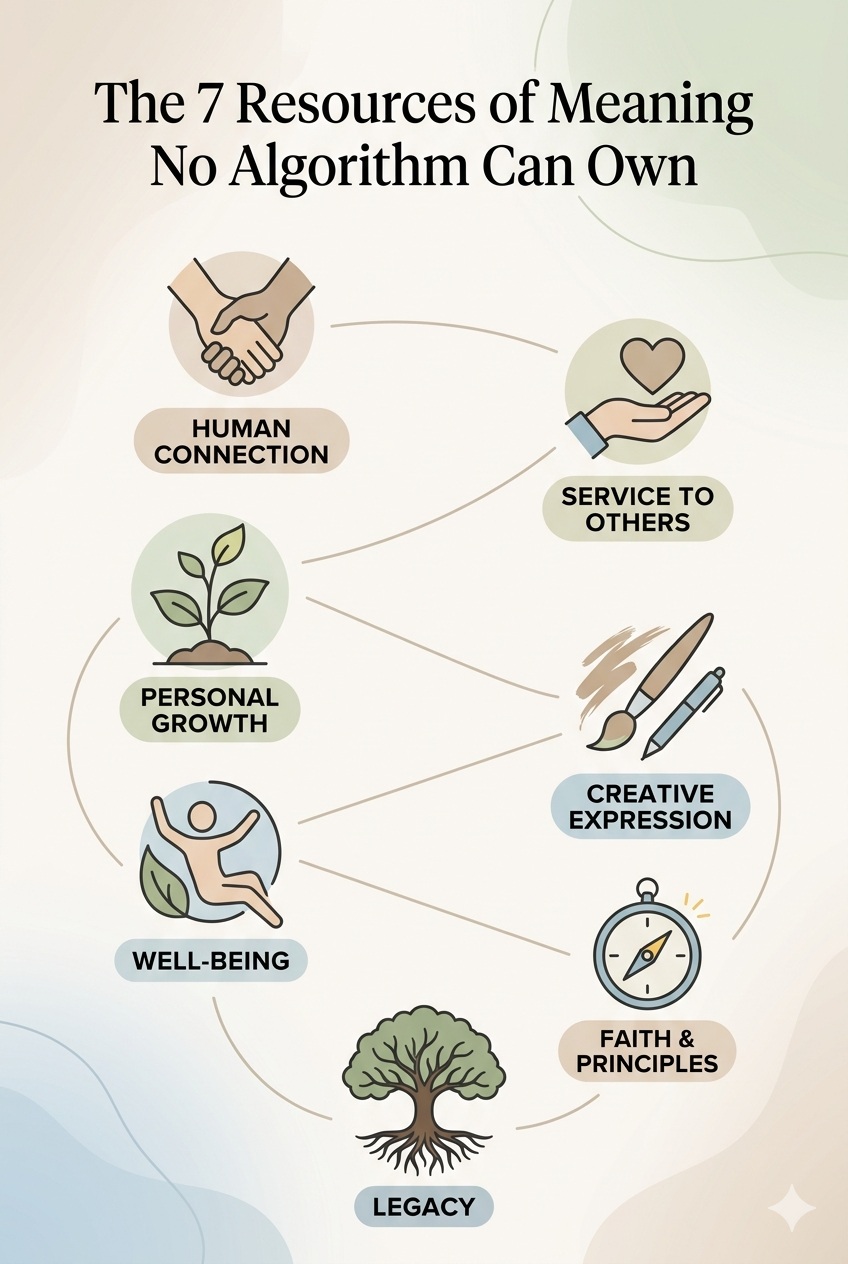
1. Real Human Connections
Your relationships with your life partner, your children, or even just one true friend are the first source of meaning. Meaning comes from someone loving you for who you are, not your job title.
2. A Service You Give To Others Without Reward
The deepest meaning doesn’t come from taking, it comes from giving. Regardless of whether it’s volunteering or teaching, providing service helps you move from the “I” circle into the “we” circle.
3. Your Own Personal Growth
There is a huge difference between existing and being alive. When you are growing, you are alive. A system can learn, but it doesn’t grow or have moments of breakthrough.
4. Your Creativity In Self-Expression
A bot can write a poem, but it cannot write your poem because it didn’t experience your life.
5. Your Physical and Mental Well-being
We are not minds carrying bodies, but bodies endowed with minds. When you move your body, you’re not just burning calories, you’re reminding yourself you’re alive.
6. Your Faith and Principles
Honesty, Justice, Mercy, and Responsibility are constant values that can guide us through the ups and downs of life.
7. The Legacy You Want To Leave Behind
People will remember how you made them feel, and the time you were at their side when no one else was. A machine will leave behind no legacy because it was never alive.
The Rebuilding Protocol: Your 21-Day Blueprint
If the floor has fallen out from under you, your first reaction is to run or apply to 100 jobs in a panic.
Please don’t. Panic is a horrible designer. You cannot rebuild your professional life on shaky ground.
First, you need Recovery: you need to become yourself again.
Week One: Accept What Happens
Most people skip this week because sitting still with the pain of loss is scary. You must count your strengths honestly.
Draw a line on a piece of paper. The left side represents what machines do best. The right side represents what only you can do. The skills represented in the right column represent the area of your career moving forward.
Week Two: Redefining Your Path
Once you know your human strengths, you have three paths to choose from:
- Path One: Remain & Evolve: If you are still working, become the individual in the room that no machine can replicate. Focus on “Human Triggering” where your gut feelings and judgment are needed.
- Path Two: Take A Bridge To The Future: Identify a Bridge, which is an existing skill you already possess that will allow you to transition from your past job to a future job.
- Path Three: Build Independently: Look at the pattern of problems people continually come to you to resolve. Develop the smallest version of a product or service that solves this, and share it with three people.
Week Three: Make It Real
Tell someone your honest story. Telling your story out loud makes your new direction real and opens doors you cannot see yet.
Stop evaluating your week by productivity logs, and ask yourself three questions: Did I add value?
Did I grow?
Did I help people well?.
Raising The Next Generation
From another perspective, if you have children, you must stop telling your children to build their identity solely around their job. Your children will need a totally new definition of the question “Who am I?”
Teach your child how to ask good questions, not how to memorize ready-made answers.
Ask them, “What makes people love you?” instead of “What do you want to be when you grow up?”
Teach them mental resilience before academic achievement.
Human skills like empathy, deep communication, and leading with heart will become the most valuable currency of their time.
Your Final Truth
You are not in failure. The system is in disarray. You have no control over how the game was changed in the middle of the game.
However, you will be responsible for what you choose to do next.
You live for a reason, not for an economic reason.
You did not come into this world to execute tasks.
You came to feel, to love, to create, to build, and to leave an impact.
Sometimes the loss of one version of the self becomes the beginning of a truer one.
Don’t make yourself optional. Make yourself irreplaceable, not by what you do, but by who you are.
If this reached a quiet place inside, Don’t Make Yourself Optional: The Meaning Crisis When AI Takes Everything Else goes deeper into that wound and the path out of it. Read it, and if it speaks to something real, leave a review. That simple act helps the book reach others standing in the same silence.
I hope you enjoyed the story.

Mohamed Bakry Aboulfotouh is an author, entrepreneur, and business consultant with over 20 years of experience helping freelancers and SMEs build intelligent, client-focused systems. He specializes in turning AI from a trend into practical, income-generating solutions. As the founder of Pro Bazaar AI, he focuses on transforming AI assets into real business tools. Through his Medium publication, How to Profit AI, he shares insights that blend technical expertise with real-world experiences on how technology both empowers and challenges human identity.





Leave a Reply