
Quick Snapshot
“Change Hitting Hard At Work? This Guide Gives Executives A Practical Self Care Playbook To Stay Sharp Through Organizational Shifts—Protecting Energy, Focus, And Credibility When Pressure Peaks. Want To Lead The Transformation Without Burning Out In The Process?”
Organizational change can look tidy on paper—timelines, milestones, communication plans. But for executives living it, change becomes a nonstop cycle of high-stakes decisions, emotional labor, and constant visibility. Without protecting energy, clarity, and recovery, leadership effectiveness often becomes the first thing that quietly breaks.
Here’s the upside: executive self care doesn’t need a “wellness” label. Treat it like a structured leadership system—just as a program for leadership development would—and it starts delivering measurable steadiness when everything else shifts. One question: will the change run you, or will you run the change?
Why Executive Self Care Matters More During Organizational Change
Change turns the executive chair into a signal tower; people read meaning into every pause and decision. Pressure expands in three directions—thinking, feeling, and being watched—so self care protects judgment when uncertainty spikes.
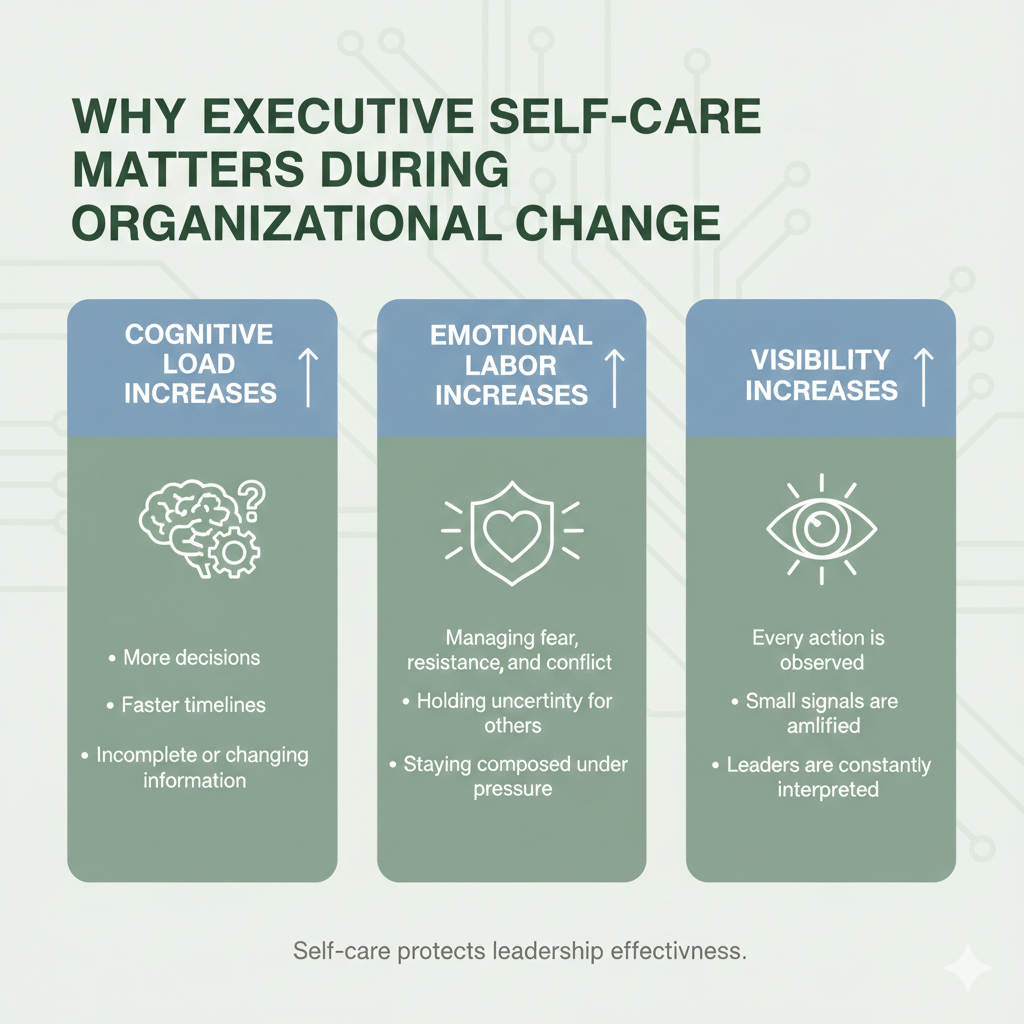
- Cognitive Load Rises (More Decisions, Faster Cycles, Incomplete Data).
- Emotional Labor Rises (Managing Fear, Resistance, Conflict, Uncertainty).
- Visibility Rises (People Watch What You Do More Than What You Say).
Change Overload Increases Leadership Strain
PwC’s survey shows more than half of workers feel too much change hits at once, while 44% don’t understand why change needs to happen. That “why gap” creates clarity debt for executives: every unclear message triggers follow-up calls, side-channel speculation, and calendar creep. Leaders repeat the story, correct misquotes, and calm nerves after rumor spikes, which steal attention from decisions that move the change forward.
Stress Isn’t Just “Part Of The Job”
CDC/NIOSH defines job stress as harmful physical and emotional responses when job requirements don’t match a worker’s capabilities, resources, or needs. During change, executives often stack new dashboards, new tools, and tighter timelines onto the same headcount and the same hours. Inbox volume climbs, decision windows shrink, and recovery time disappears. That mismatch turns pressure into chronic strain that can erode health and raise injury risk.
Burnout Risk Rises When Stress Isn’t Managed
WHO describes burnout as chronic workplace stress that leaders don’t manage successfully, marked by exhaustion, cynicism, and reduced professional efficacy. Executives rarely collapse overnight; burnout reshapes behavior first. Exhaustion narrows thinking, cynicism sharpens language, and reduced efficacy slows follow-through. Teams notice the shift fast: clipped replies, delayed decisions, and thin empathy in conflict. That leadership drift then fuels resistance and stalls adoption.
Key Drivers of Executive Strain During Organizational Change
Change management maps drivers that push an organization forward. Executive self care during organizational change needs a second map: drivers of strain that drain energy, spike stress responses, and distort decision quality. Spot these drivers early, and strain stops hijacking leadership capacity. Keep going—each driver leaves a different fingerprint.
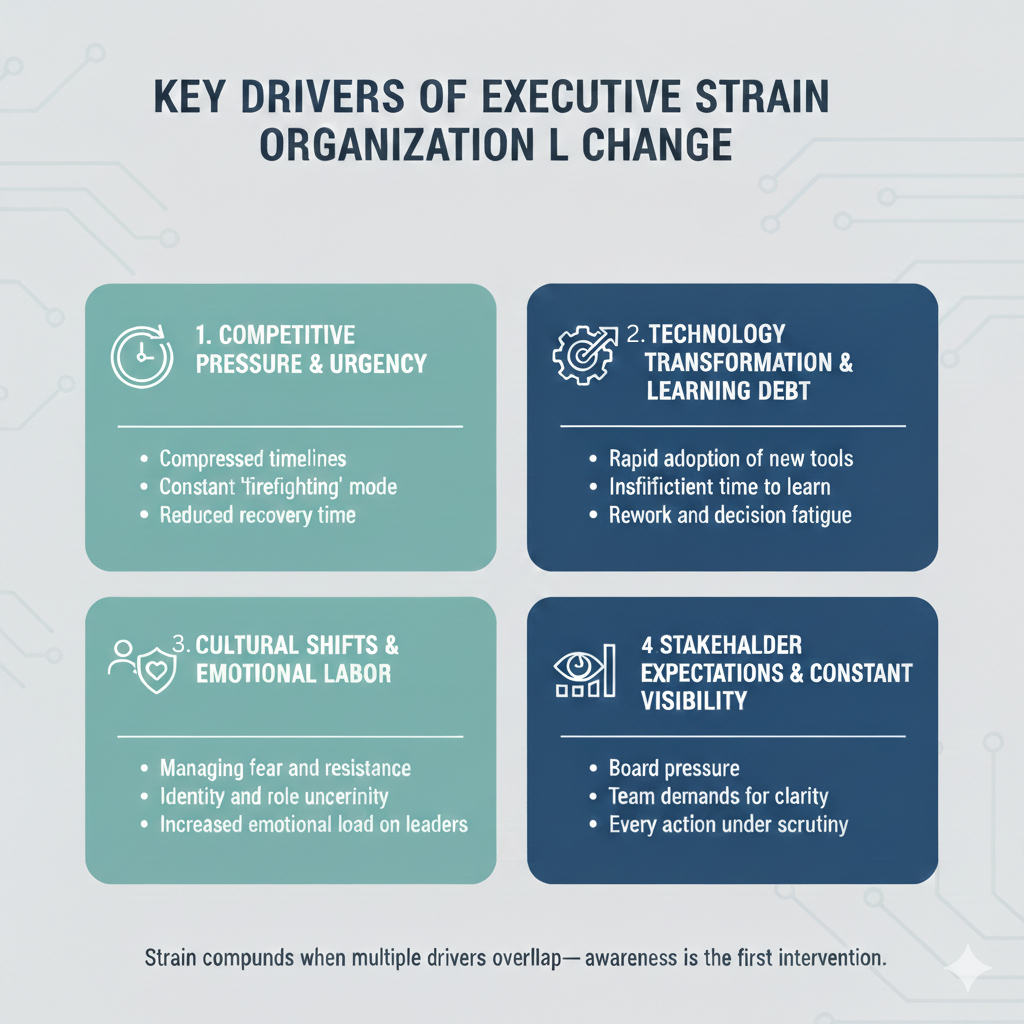
Competitive Pressure And Urgency
Competitive threats compress timelines and push leaders into permanent sprint mode, a pattern that research links to change fatigue when organizations stack repeated reorganizations and uncertainty. Common signals include: urgency crowds out recovery, then judgment narrows.
- Back-To-Back Meetings Without Breaks
- Shortened Sleep
- Reactive Decision-Making
- Reduced Patience In Conversations
Technology Transformation And Learning Debt
Digital shifts and GenAI adoption create learning debt: leaders approve tools faster than teams absorb them, so confusion turns into rework, escalations, and avoidable friction. Research on digital transformation highlights the “human side” and the leadership competencies required to integrate digital knowledge, not just deploy systems. (ScienceDirect) Practical reality: skipped learning time rarely saves time; it often multiplies it through downstream errors.
Cultural Shifts And Emotional Labor
Culture change triggers an identity threat—people fear loss of status, competence, or belonging—so executives absorb tension in every town hall, talent review, and conflict loop. Evidence shows leadership strain rises during major change and can ripple outward through teams. Next up: emotions drive readiness. Research links culture and leadership to change readiness with emotional intelligence as a key pathway, which explains why emotional labor spikes at the top. (SA Journal of Human Resource Management)
Stakeholder Expectations And Constant Visibility
Boards demand speed and results, teams demand clarity, and customers demand stability—so executives carry competing scorecards in the same hour. Reuters reported rising board-management tension in a PwC/Conference Board survey, including executives reporting board interference in day-to-day decisions. Importantly, visibility amplifies everything: one delayed decision signals doubt, one sharp reply fuels rumor, and stakeholder pressure tightens the squeeze.
Common Obstacles To Executive Self Care
Executives don’t skip self care because they doubt it; the operating system around them blocks it. During change, calendars fill, approvals centralize, and the culture rewards speed over recovery. Spot these obstacles early, and self care stops feeling selfish and starts functioning like leadership infrastructure.
The Hero-Leader Trap
Hero leadership turns every hiccup into a personal rescue mission. When one leader owns every escalation, teams learn to wait, not solve. MIT Sloan Management Review (via Skillsoft) highlights how a “hero complex” can sabotage change by shrinking listening and over-centralizing action.
Boundary Erosion And “Always-On” Cultures
Always-on norms shred boundaries fastest through messages. LSE research on out-of-hours email explains how constant digital reach keeps work alive past dinner, which crowds out real recovery. Here’s the damage: executives trade strategic thinking for perpetual responsiveness.
Isolation At The Top
Top roles shrink the number of “safe” conversations. Research reviews describe leader loneliness as common and consequential, often tied to weak support structures and limited recognition channels. Without honest processing, stress loops run louder and longer.
Misaligned Incentives
Reward systems can quietly punish self care. A 2025 Journal of Human Resources study links structured bonus and promotion practices with higher odds of overtime. That signal pushes leaders to prove commitment through hours, not outcomes—especially during change sprints.
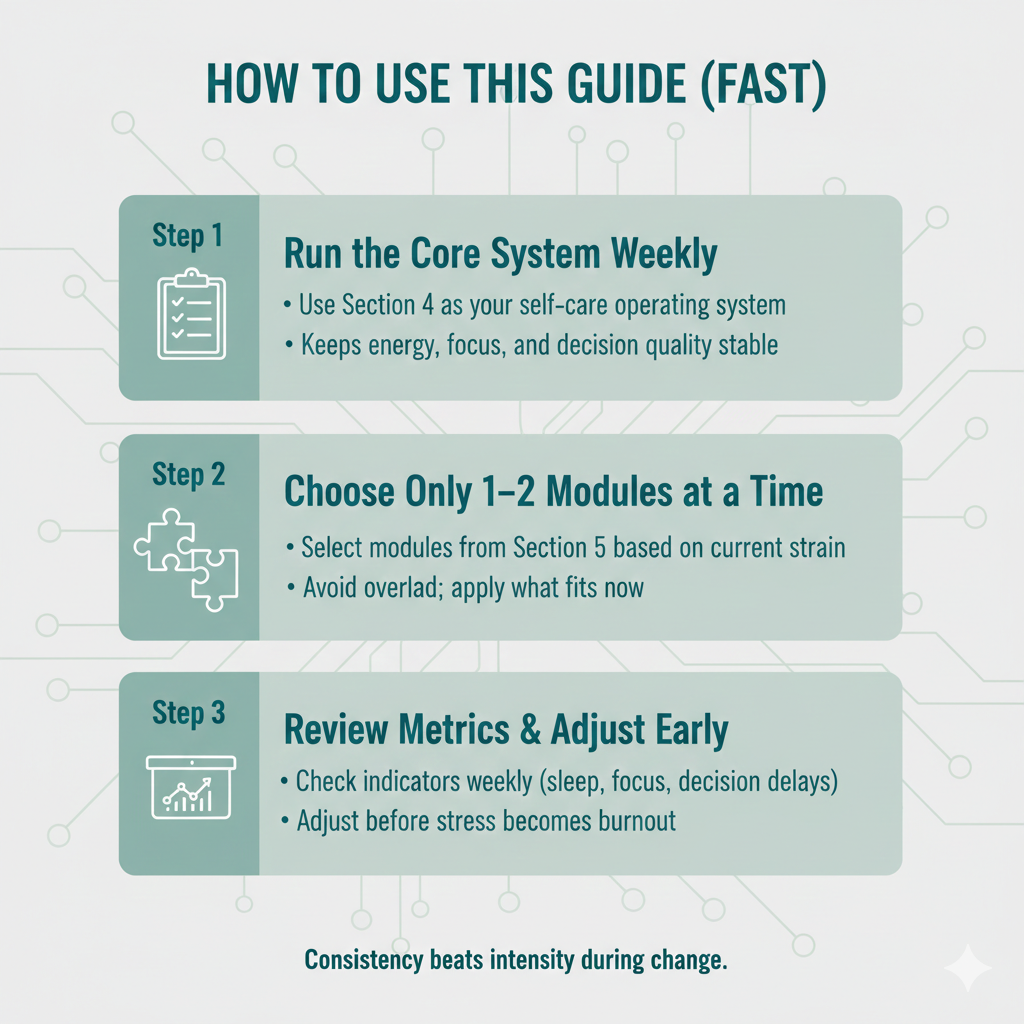
How To Use This Guide (Fast)
Run Section 4 weekly As Your Self Care Operating System.
Choose no more than 2 Modules from Section 5 at a time based on where the strain shows up most.
Review the metrics in Section 7 weekly and adjust early—before stress becomes leadership drift.
A Structured Executive Self Care Framework For Change (Operating System)
Organizational change rewards leaders who operate with clarity, stamina, and steady judgment. Executive self care works best when treated as an operating system—a small set of repeatable controls that still function in high-pressure weeks. Use this OS first.
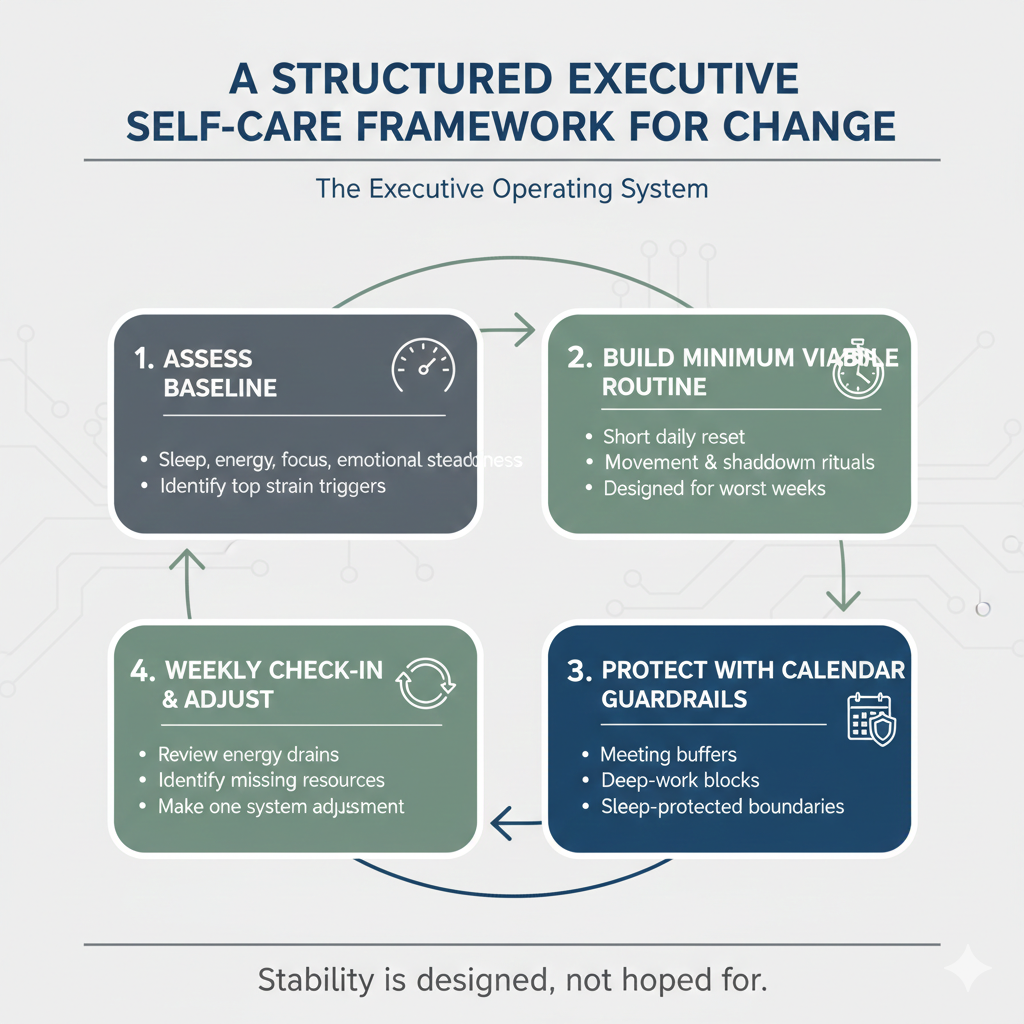
Assess Your Baseline (Before The Next Wave Hits)
Use a fast baseline that fits executive reality. Score 1–10 on: sleep quality, physical energy, emotional steadiness, focus, patience in conflict, and sense of meaning. Then capture the top three strain triggers that show up during change (e.g., uncertainty, conflict, overload, public scrutiny).
The benefit is practical: early data reveals patterns before performance starts slipping.
Add Two Prompts To Your Baseline:
- “What decision am I delaying, and why?”
- “What interaction triggered the most stress this week?”
Build A Minimum Viable Routine (Designed For Your Worst Week)
Design a routine that survives chaos. Use three anchors:
- 2-Minute Reset Before The First High-Stakes Meeting (quiet + intention-setting)
- 7–12 Minute Movement Break after the most intense block
- 2-Minute Shutdown Note at day’s end (tomorrow’s first action + one boundary)
During change weeks, consistency beats intensity. This routine protects recovery without requiring “perfect conditions.”
Protect The OS With Calendar Controls (Guardrails, Not Willpower)
Calendars determine stress exposure. Put simple controls in place:
- Two Daily 5-Minute Buffers between meetings
- One Weekly Deep-Work Block (60–90 minutes) for decisions that move the change
- Three Sleep-Protected Nights with a fixed cutoff for messages (except true emergencies)
Without guardrails, urgency takes over every hour and recovery disappears.
Set Up A Weekly Check-In To Make Early Adjustments And Stay On Course
Do a 10-Minute Weekly Review:
- Top Demand: What consumed the most energy this week?
- Missing Resource: What was absent—time, staffing, clarity, authority, sequencing?
- One Adjustment: Redesign a recurring meeting, clarify decision rights, remove a low-value approval step, or shift sequencing.
Track one early warning signal (sleep disruption, shorter temper, delayed decisions). If it appears two weeks in a row, adjust the system immediately.
Essential Self Care Strategies As Modules (Mapped To The Operating System)
These modules are optional add-ons you apply based on where strain is showing up.
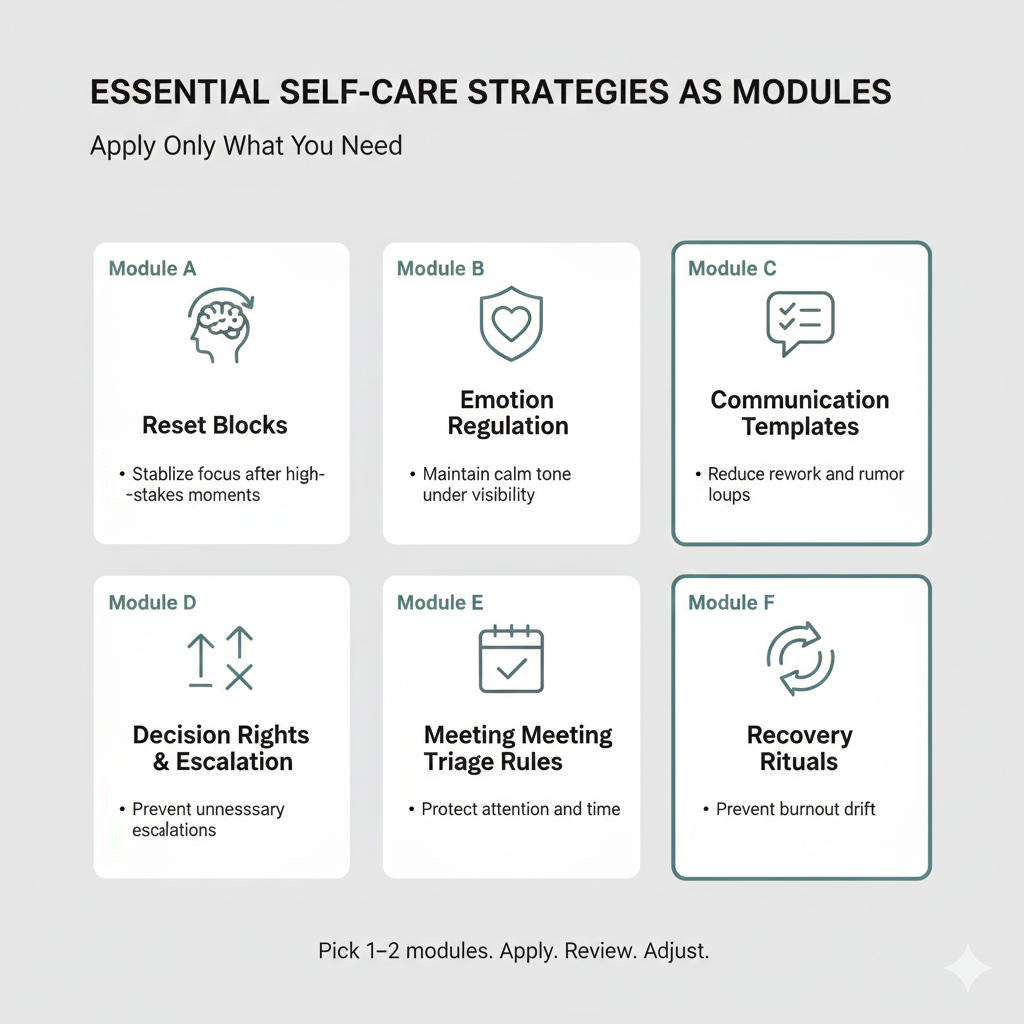
Module 5A — Reset Blocks To Stabilize Performance (Maps To OS 4.2 + 4.3)
Purpose: protect cognition after high-stakes moments.
Schedule a 25-minute reset block after any of these triggers: conflict meeting, layoffs planning, budget cuts, executive committee debate. Use it for a short walk, hydration, and breathing that lowers physiological arousal before the next decision.
Add a simple travel-proof rule during sprints: avoid stacking late stakeholder events with early critical meetings whenever possible.
Module 5B — Emotion Regulation For High Visibility Moments (Maps To OS 4.2)
Purpose: prevent stress from hijacking tone.
Before A High-Stakes Room, Run A 60-Second Pre-Brief:
- Goal (Alignment/ Clarity / Decision)
- Risk (Defensiveness/ Urgency Spirals / Conflict)
- Tone (Calm/ Warm / Precise)
During Heat: Pause → Slow Exhale → Ask One Clarifying Question that forces specificity. After conflict: send a clean recap (decision, owner, deadline) to prevent repeat loops.
Module 5C — Communication Templates To Reduce Rework (Maps To OS 4.3)
Purpose: cut repeat questions and rumor-driven escalation.
Use One Consistent Structure For Change Messaging:
- What’s Changing (one sentence)
- Why Now (one sentence)
- What Stays Stable (one sentence)
- What Happens Next (three steps)
- Where Questions Go (one channel)
Add a one-page “FAQ spine” covering: job impact, timelines, decision owners, success definition, and support available. This reduces “same meeting, different room” repetition.
Module 5D — Decision Rights + Escalation Design (Maps To OS 4.3 + 4.4)
Purpose: stop bandwidth loss from unnecessary escalations.
Set Decision Rights Early:
- One Accountable Owner Per Change Stream (tech, org design, comms, capability)
- Clear Rules For What Requires Exec Approval Vs Manager Ownership
- An Escalation Ladder: What Qualifies As Escalation, Where It Goes, And Response Time
Then review weekly with this question: “Where could clearer decision rights have prevented escalation?”
Module 5E — Meeting Triage Rules To Protect Attention (Maps To OS 4.3)
Purpose: treat attention like capital allocation.
Cancel or Delegate Meetings That Fail This Test:
- Requires A Decision Only You Can Make
- Prevents A Major Risk
- Unlocks A Stalled Dependency
- Aligns Leaders On A Single Message
Replace routine updates with written briefs, and schedule meetings only for exceptions or decisions.
Module 5F — Recovery Rituals That Prevent Burnout Drift (Maps To OS 4.2 + 4.4)
Purpose: make recovery predictable, not accidental.
Two Rituals That Executives Actually Use:
A) Post-Conflict Decompression (7 minutes):
- Write The Outcome In One Sentence
- List Next Two Actions
- Short Walk/Stretch
- Send One Follow-Up That Prevents Re-Litigation
B) Weekly Reset (20 minutes):
- Identify The Biggest Drain And Why It Happened
- Remove or Redesign One Recurring Stressor
- Schedule One Renewal Block That Does Not Move
Training And Soft Skills As Executive Self Care
Training acts like preventative maintenance during change: it converts confusion into capability before it hits the exec desk. Done right, learning reduces escalations, shortens adoption time, and protects leadership bandwidth.
Create Role Based Learning Paths For Leaders
Middle managers translate change into daily work, so training them saves executive oxygen. Prosci research highlights manager and supervisor support as a top contributor to change success, with 84% rating their involvement extremely important. Here’s the lever: build 20-minute manager drills, tool job-aids, and resistance role-plays tied to milestones directly.
Use Microlearning To Prevent Overload
Skip long workshops during reorg weeks. Now watch: microlearning fits between meetings and leverages spaced repetition to improve retention. Ship 5–7 minute modules that answer one question: “What should a manager do this week?” Add a single job aid and a short recall quiz, then run it again next week to reinforce the behavior.
Strengthen Soft Skills That Reduce Stress
Gartner’s April 2025 research found that many leaders view change as a key stressor for their teams, and fewer than half of employees reported meeting their change goals. Here’s the play: run 20-second message drills, practice “listen-reflect-decide” in conflict scenarios, and coach managers on performance conversations under uncertainty so escalations drop and decisions speed this quarter.
Measuring The Success of Your Executive Self Care Plan
Metrics keep executive self care practical during change. Track signals that protect decision quality, relationships, and stamina. A small dashboard beats vague intentions, so review it weekly and adjust fast today.
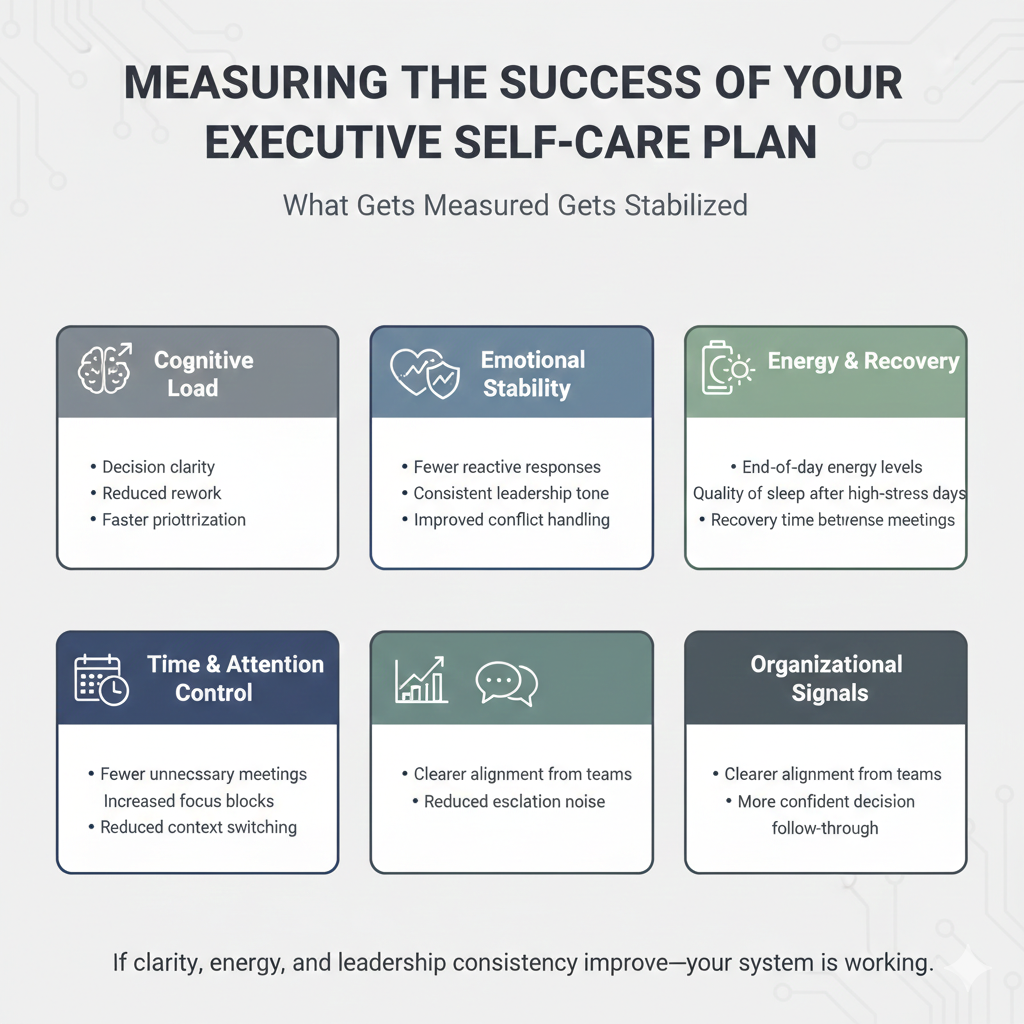
Set Measurable Objectives
Choose 3–5 indicators tied to leadership capacity, not wellness trivia. Track decision latency on critical items, escalation volume from managers, after-hours message count, meeting-to-output ratio, and rework rate on change deliverables. If numbers climb for two weeks, capacity is shrinking long before burnout shows up in behavior, too.
Monitor Behavioral Changes (Your Early Warning Signals)
Watch for behavior shifts that predict leadership drift: interrupting more, delaying tough calls, snapping at minor questions, avoiding stakeholder updates, and sending late-night “just checking” pings. Here’s the catch: these signals show stress in real time. Capture them in a weekly note, then act within 48 hours, immediately, not later.
Analyze Feedback And Data
Use data from others to spot blind spots. Ask the chief of staff for recurring friction points, ask direct reports where confusion creates rework, and scan your calendar for low-leverage meetings that trigger context switching. Next up: compare the dashboard to change milestones; tighten scope or staffing when gaps widen.
Leading A Supportive Culture Without Sacrificing Yourself
Executives shape culture fastest through what they tolerate, reward, and repeat. During change, a supportive culture protects your stamina because it reduces fear-driven churn, rumor spirals, and unnecessary escalations. Set norms that keep performance high without burning leaders out.

Avoid “Wellness-Washing”
Pair well-being talk with visible operating rules. Publish two guardrails leaders must follow: no after-hours approvals unless severity level 1, and no “ASAP” requests without a deadline plus business impact. Track violations through the chief of staff, then correct patterns publicly. Here’s the proof: when leaders enforce workload rules, teams stop performing exhaustion to look committed.
Make Psychological Safety Real During Changes
Build safety into decision routines, not slogans. Require one named “red team” voice in exec meetings to surface risks before final calls. Create a bad-news channel with a 24-hour response rule, then praise early risk reporting. Next up: use three-part uncertainty language—what leaders know, what leaders don’t know, and the next update date—so fear doesn’t fill gaps.
Wrapping Up
Organizational change tests more than strategic skill; it tests the leader’s capacity to stay clear, steady, and credible under pressure. A self care operating system protects that capacity by surfacing stress drivers early, removing hidden blockers, and running simple routines that safeguard sleep, focus, and recovery. Now consider this: if the leader’s energy collapses, what happens to the change? Start today—lock one recovery window, tighten one boundary, and train one layer of managers to reduce friction. Ready to lead longer, not louder?

Hi, I’m Arvind. I write about mindful living, emotional wellbeing, self-growth, and the small everyday moments that help us feel calmer and more connected. Through thoughtful articles and meaningful conversations, I hope to create a peaceful corner on the internet for anyone trying to slow down and live more intentionally.







Leave a Reply